Eating more whole plant foods doesn’t have to mean spending hours chopping, blending, and cooking every day. Having a few versatile kitchen tools can make preparing healthy plant-based meals faster, easier, and much more enjoyable.
Whether you’re just beginning to eat more plant-based foods or have been doing it for years, these are five kitchen essentials that can make a real difference in your everyday cooking.
Affiliate Disclosure: As an Amazon Associate I earn from qualifying purchases. This means I may earn a commission if you purchase through links on this page, at no additional cost to you.
1. A Good Food Processor
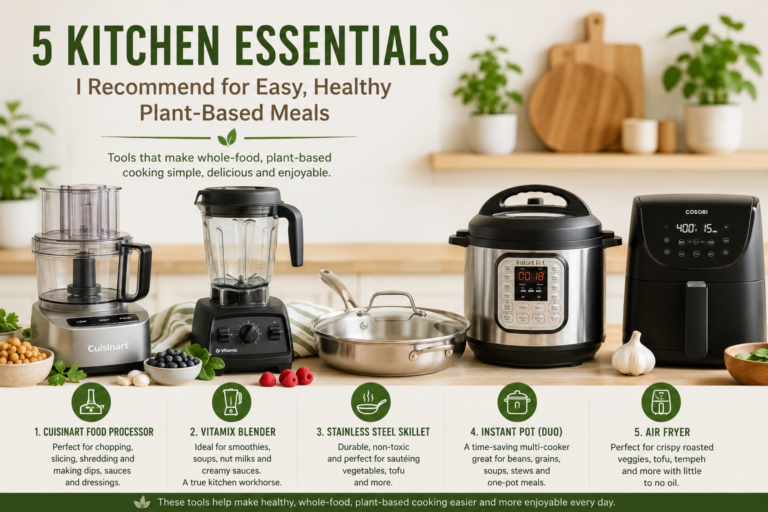
A food processor is one of the most useful tools in a plant-based kitchen. I particularly like Cuisinart food processors because they can handle so many everyday food-preparation tasks.
You can use a food processor to chop vegetables, shred carrots and cabbage, make hummus and bean dips, prepare homemade veggie burgers, chop nuts, and blend ingredients for sauces and dressings.
If you cook with lots of fresh vegetables and whole-food ingredients, a good food processor can save a tremendous amount of chopping and preparation time.
Click here to see my pick: Cuisinart Food Processor
2. A High-Powered Vitamix Blender
A high-powered blender is especially useful when you want to create creamy textures without relying on dairy products.
A Vitamix blender can be used for smoothies, soups, sauces, hummus, salad dressings, nut-based sauces, and much more.
It is particularly good at turning ingredients such as cashews, beans, fruits, and vegetables into exceptionally smooth mixtures. A powerful blender can make it much easier to experiment with homemade plant-based sauces and dressings instead of relying on packaged versions.
Click here to view my pick: Vitamix Blender
3. An Air Fryer or Air Fryer/Convection Toaster Oven
An air fryer is a great way to give vegetables and other plant foods a delicious browned or crispy texture without deep frying.
I especially like the versatility of a combination air fryer/convection toaster oven. Depending on the model, one appliance can air fry, roast, bake, broil, and toast.
Try using it for Brussels sprouts, cauliflower, broccoli, potatoes, chickpeas, tofu, or a colorful mixture of roasted vegetables.
It’s also convenient when you’re preparing a smaller meal and don’t want to heat up your full-size oven.
My Pick: Air Fryer/Convection Toaster Oven
4. An Instant Pot or Electric Pressure Cooker
Beans, lentils, and whole grains are staples in many whole-food, plant-based kitchens, and an electric pressure cooker can make preparing them much easier.
An Instant Pot or similar multi-cooker can be used for dried beans, lentils, brown rice, steel-cut oats, soups, stews, chili, and many other plant-based meals.
One of its biggest advantages is convenience. Once your ingredients are in the pot and the cooking program is started, the appliance does much of the work for you.
It’s especially helpful if you’d like to cook more beans from scratch rather than relying exclusively on canned beans.
Click here to see my pick: Instant Pot or Electric Multi-Cooker
5. A Quality Stainless Steel Skillet
You don’t need an electrical appliance for every job in the kitchen. A quality stainless steel skillet is one of the most versatile pieces of cookware you can own.
Stainless steel is durable, long-lasting, and doesn’t rely on a nonstick coating. It’s a good option for sautéing mushrooms, onions, peppers, greens, tofu, and countless other plant-based foods.
If you’re accustomed to nonstick cookware, stainless steel may take a little practice. Properly preheating the pan and adding small amounts of water or vegetable broth when needed can help when you’re cooking with little or no added oil.
Look for a sturdy, multi-ply stainless steel skillet, which generally provides more even heating than a thin, inexpensive stainless steel pan.
Click here to see my pick: Multi-Ply Stainless Steel Skillet
A Plant-Based Kitchen Doesn’t Have to Be Complicated
You don’t need a kitchen filled with specialty gadgets to enjoy a whole-food, plant-based lifestyle. A handful of well-chosen tools can make it much easier to turn vegetables, fruits, beans, lentils, whole grains, nuts, and seeds into delicious everyday meals.
If I were setting up a plant-based kitchen from scratch, these five items would be near the top of my list. More importantly, choose the tools that fit the way you like to cook. The best kitchen equipment is the equipment you’ll actually use.