
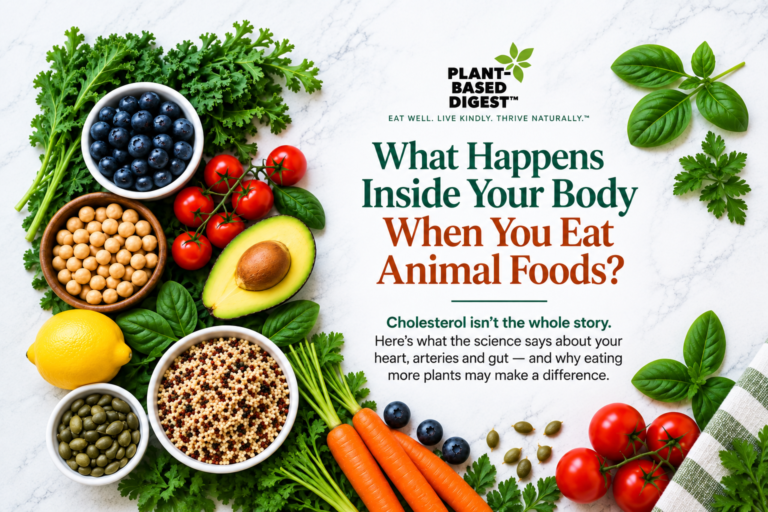
Cholesterol isn’t the whole story. Here’s what researchers are learning about your arteries, TMAO, IGF-1—and why eating more plants may make a difference.
By Francine Cohen | Plant-Based Digest
Most of us have heard that eating too much saturated fat can raise cholesterol.
But that’s only part of the story.
Scientists have discovered that the foods we eat may affect our heart and blood vessels in ways we can’t see or feel.
A meal can affect how well our arteries relax. Certain foods can cause our gut bacteria to produce substances linked to heart disease. And the type of protein we eat may even affect hormones involved in growth and aging.
It sounds complicated.
It really isn’t.
Let’s break it down.
First, Meet the Inside of Your Arteries
Your arteries aren’t just pipes carrying blood around your body.
The inside of every blood vessel is covered by a very thin layer of cells called the endothelium.
Think of it as the protective lining inside your arteries.
When it’s healthy, it helps your blood vessels relax and open so blood can flow easily.
One way it does this is by producing something called nitric oxide.
You don’t need to remember the name.
What matters is this:
Healthy arteries should be able to relax and open when your body needs more blood.
And what we eat can affect how well they do that.
Can One Meal Really Affect Your Arteries?
Surprisingly, yes.
Researchers have given people high-fat meals and then measured how well their arteries could expand afterward.
Within hours, the arteries weren’t working as well.
The effect was temporary—but it was measurable.
That doesn’t mean one unhealthy meal suddenly gives someone heart disease.
It means that your body responds to what you eat almost immediately.
And if a certain type of meal temporarily affects your blood vessels once, it’s reasonable to ask what happens when meals like that are eaten over and over, day after day.
See the original research on high-fat meals and artery function
So What About Eggs?
Eggs are interesting because there are a couple of different issues to consider.
They contain cholesterol, but they are also rich in something called choline.
Your body needs some choline.
But here’s where things get interesting.
Certain bacteria living in your intestines can use choline to help produce another substance called TMAO.
And TMAO has attracted a lot of attention from heart researchers.
Dr. Michael Greger of NutritionFacts.org has also reviewed research looking specifically at eggs and artery function.
Read Dr. Greger’s explanation of eggs and arterial function
What in the World Is TMAO?
The name sounds intimidating.
The idea isn’t.
Imagine this:
You eat certain foods.
Your gut bacteria break down parts of those foods.
They produce a substance that your liver then turns into TMAO.
Researchers have found that people with higher levels of TMAO in their blood have also had higher rates of serious cardiovascular problems in some studies.
That doesn’t mean TMAO is the only cause of heart disease—or that everyone with a high TMAO level will have a heart attack.
Heart disease is much more complicated than that.
But TMAO appears to be another piece of the puzzle.
Which Foods Are Involved?
Two of the nutrients that can feed this process are carnitine and choline.
Red meat is especially rich in carnitine.
Eggs are a concentrated source of choline.
And researchers have actually tested what happens when people eat red meat regularly.
Their TMAO levels went up.
When they stopped eating the red meat, the levels came back down.
In other words, changing the food changed what was happening inside the body.
Read the controlled red-meat and TMAO study
But Don’t Plants Contain Choline Too?
Yes!
And this is where nutrition can get confusing if we look at one nutrient instead of the entire food.
Broccoli, beans and other plant foods can contain choline.
That doesn’t mean broccoli behaves in your body the same way an egg does.
Why?
Because foods don’t come into our bodies as isolated nutrients.
Beans come with fiber.
Vegetables come with fiber and thousands of naturally occurring plant compounds.
And what you regularly eat can even influence the types of bacteria living in your gut.
That’s one reason the overall pattern of your diet matters so much.
You don’t need to be afraid of beans or broccoli because you’ve heard about choline.
What About Chicken?
Chicken brings up a different subject.
This time we’re talking about something called IGF-1.
Again, forget the complicated name for a moment.
IGF-1 is a normal hormone your body needs for growth and repair.
We all have it.
The question researchers have been studying is whether diets containing a lot of animal protein may be associated with higher levels of IGF-1.
Some research has found that people eating vegan diets have lower average IGF-1 levels than people eating diets containing animal foods.
For example, one study found IGF-1 levels were about 9% lower in vegan men, while another found levels about 13% lower in vegan women compared with other dietary groups.
That doesn’t prove that eating a piece of chicken causes disease.
It does suggest that where our protein comes from may matter, and it’s one more reason researchers are interested in comparing animal and plant proteins.
Why Dr. Caldwell Esselstyn Talks So Much About the Endothelium
If you’ve followed plant-based nutrition for heart health, you’ve probably heard of Dr. Caldwell Esselstyn.
Much of his work focuses on protecting that delicate lining of our arteries we talked about earlier—the endothelium.
His approach to people with serious coronary artery disease has centered on whole plant foods such as:
- Vegetables
- Beans and lentils
- Whole grains
- Fruit
while eliminating animal foods and added oils.
Some of his highly compliant patients experienced remarkably few additional cardiac events, and some showed evidence that their disease had stabilized or improved.
His research has limitations. His patients were highly motivated, the study wasn’t a large randomized trial, and cholesterol-lowering medication was also part of the treatment.
Still, his work helped bring attention to an important idea:
What if food isn’t just about lowering a cholesterol number? What if it can also help create an environment in which our blood vessels function better?
Read Dr. Esselstyn’s published coronary-disease follow-up
And What About Inflammation?
Dr. Joel Fuhrman and other plant-based physicians frequently talk about another piece of the puzzle: chronic inflammation.
Inflammation isn’t always bad.
If you cut your finger, inflammation helps your body heal.
The problem is ongoing, low-level inflammation that continues when we don’t need it.
Diet is only one factor involved, but what we eat can influence the overall environment inside our bodies.
Whole plant foods give us something animal foods simply don’t:
Fiber.
They also provide thousands of naturally occurring plant compounds, including antioxidants and polyphenols.
That’s one reason nutrition research increasingly looks at dietary patterns, rather than trying to blame or praise one individual food.
So What Should We Actually Eat?
This is the easy part.
You don’t have to memorize TMAO.
You don’t have to remember what IGF-1 stands for.
And you definitely don’t need to give your family a lecture about endothelial cells at dinner.
Just put more whole plant foods on your plate.
Start your morning with oatmeal, berries and ground flaxseed.
Make beans, lentils or tofu the center of a meal instead of meat.
Eat plenty of leafy greens.
Add colorful vegetables.
Choose whole grains.
Eat fruit.
Snack on nuts and seeds.
The science may be complicated. The food doesn’t have to be.
The Big Picture
Nutrition research is rarely as simple as saying:
“Eat this and you’ll get heart disease.”
or
“Eat this and you’ll never get sick.”
That’s not how our bodies work.
But when we step back and look at the bigger picture, something important emerges.
What we eat can affect our cholesterol.
It can affect the bacteria living in our gut.
It can affect substances such as TMAO.
It may influence hormones such as IGF-1.
And it can affect how well the delicate lining of our blood vessels functions.
The wonderful part is that we make food choices several times every day.
Every meal is another opportunity to give our bodies more of the foods that help support good health.
And perhaps that’s the most useful lesson of all.
Want to Dig Deeper?
If you’d like to see some of the research behind this article:
High-fat meals and artery function
Vogel, Corretti & Plotnick — American Journal of Cardiology
Eggs and arterial function
Dr. Michael Greger — NutritionFacts.org
TMAO and cardiovascular risk
Tang et al. — New England Journal of Medicine
Red meat and TMAO
Controlled feeding study — European Heart Journal
Plant versus animal meat
Stanford SWAP-MEAT randomized trial
Plant-based diets and IGF-1
Allen et al. — British Journal of Cancer
Plant-based nutrition and coronary artery disease
Caldwell Esselstyn, Jr., MD — American Journal of Cardiology
Ready to Make Plant-Based Eating Easier?
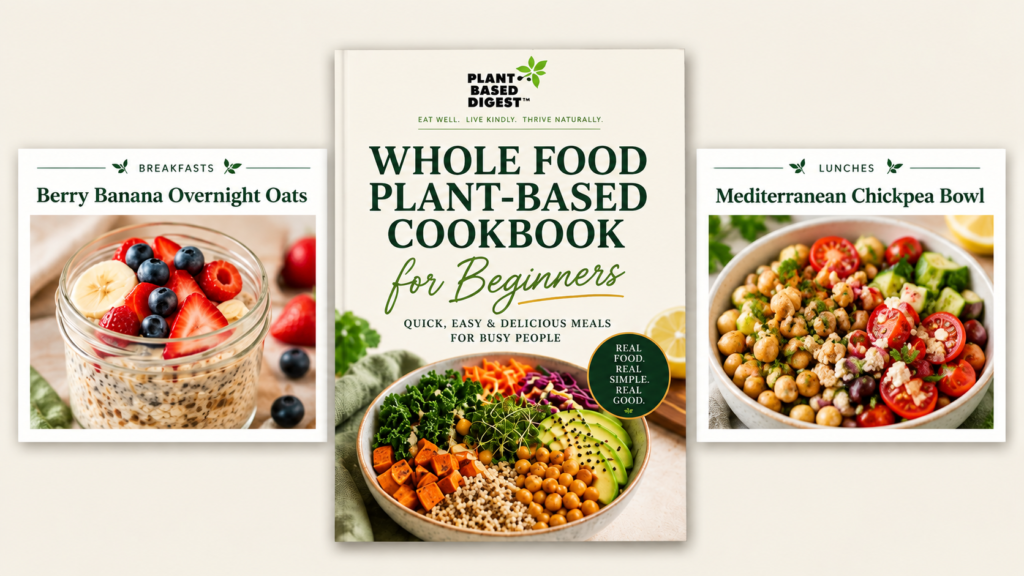
If you’re wondering what to actually put on your plate, Whole Food Plant-Based Cookbook for Beginners by Francine Cohen offers 44 approachable recipes designed to make getting started simple.
Medical note: This article is for educational purposes and isn’t a substitute for individualized medical advice, diagnosis or treatment. If you have heart disease or take medication, talk with your healthcare professional before making major dietary changes.